Foliage
Foliage is configured per biome through Foliage Data Asset references.
Foliage Data Asset
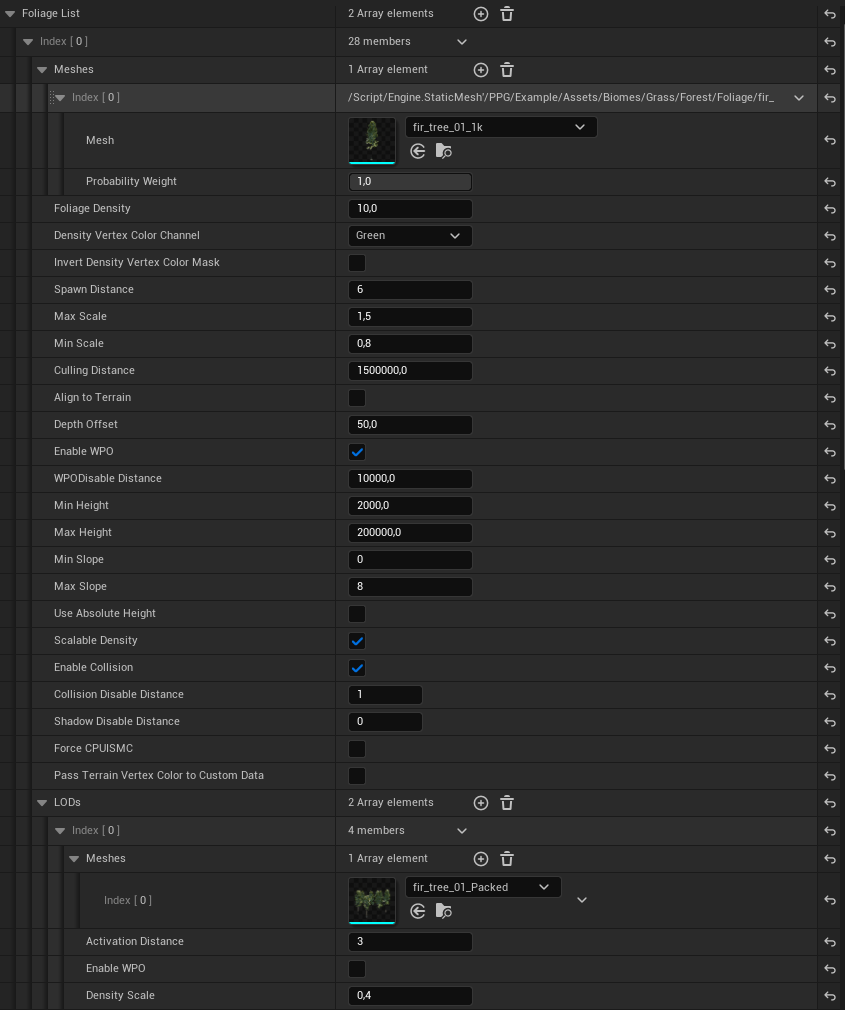
A Foliage Data Asset contains a list of foliage entries. Each entry can define:
- one or more mesh variants
- density
- spawn distance
- scale range
- culling distance
- terrain alignment
- height and slope limits
- collision behavior
- rendering behavior
- optional LOD entries
- optional deterministic clustering across chunk boundaries
Mesh Variants
Each foliage entry has a Meshes array. Each mesh variant has:
| Field | Description |
|---|---|
Mesh |
Static mesh to spawn. |
Probability Weight |
Relative selection weight, normalized among valid variants in the entry. |
Each LOD entry has a Meshes array aligned by index with the base variants. An empty LOD slot falls back to the corresponding base mesh. LODs can also change activation distance, WPO state, and density scale.
Density Masks
Foliage density can be multiplied by a terrain vertex-color channel:
NoneRedGreenBlueAlpha
Invert Density Vertex Color Mask flips the mask so dark areas spawn more foliage and bright areas spawn less.
Use this together with Planet Vertex Color Output in the generation material.
Placement Filters
Common placement controls:
| Setting | Description |
|---|---|
Min Height / Max Height |
Inclusive height range for spawning. |
Height Cutoff Smoothness |
Feather width in centimeters inside both height cutoffs. Zero keeps the height filter hard. |
Min Slope / Max Slope |
Inclusive slope range for spawning. |
Slope Cutoff Smoothness |
Feather width, using the existing slope scale, inside both slope cutoffs. Zero keeps the slope filter hard. |
Align To Terrain |
Rotates instances to terrain normals. |
Depth Offset |
Moves instances relative to the terrain surface. |
Use Absolute Height |
Treats height as always zero. |
Uniform Scale |
Uses one random value on all axes; when disabled, X/Y/Z are randomized independently inside the Scale interval. |
Positive cutoff smoothness reduces spawn probability near both ends of its allowed range. The lower ramp increases from zero at Min to full strength at Min + Smoothness; the upper ramp decreases from full strength at Max - Smoothness to zero at Max. The ramps stay inside the configured range, so smoothing never permits foliage outside the minimum or maximum cutoff.
Height and slope masks are multiplied before the deterministic spawn test. If the two ramps of one filter overlap because the allowed range is narrower than twice its smoothness, the overlap remains partially attenuated rather than being forced to full strength. Existing assets keep their previous inclusive hard-cutoff behavior because both smoothness settings default to 0.
Clustering
Enable Clustering to create deterministic groups that continue across chunk boundaries. Cluster Size Min and Cluster Size Max control the number of members; Cluster Radius controls their spread. The maximum is clamped to at least the minimum during asset validation.
Foliage Collision
Foliage physics is generated by the planet collision grid rather than by visible terrain chunks. Enable Generate Collisions and Generate Foliage Collision on the Planet Spawner, then enable Enable Collision on each foliage entry that requires physics.
Collision Range controls the maximum surface distance from a collision invoker. Range relevance is evaluated per collision cell, so a cell that intersects the range can contain collision foliage across its complete area. A negative serialized value derives a centimeter range from the deprecated recursion-distance setting.
Collision generation uses base mesh variants and evaluates the same placement inputs as rendered foliage:
- height and slope filters
- terrain alignment and depth offset
- vertex-color density masks
- scale ranges and mesh probabilities
- deterministic clustering
Distance-based PPG foliage LOD substitutions do not affect collision foliage. Collision instances are grouped by static mesh into physics-only, non-rendering instanced components. See Collision Streaming for collision-grid sizing and runtime behavior.
Runtime Limits
The spawner can globally scale or limit foliage:
Generate FoliageGlobal Foliage Density ScaleFoliage Upload Batch SizeMax Foliage Instances Per ChunkMax Concurrent GPU GenerationsMax Pooled Foliage ISM ComponentsMax Pooled GPU Foliage Components
GPU and CPU Rendering Paths
Visible foliage can use GPU foliage components even when its entry has collision enabled because physics is owned by the collision grid. Use Force CPU ISMC only when the visible instances specifically require CPU-backed instancing.
Pass Terrain Vertex Color To Custom Data exposes nearest terrain vertex color as four per-instance custom data floats.
Force Mesh LOD 0 is enabled by default. When enabled, it is a component-wide override: PPG applies it to every CPU ISMC or GPU-indirect component spawned for the foliage entry, so every instance belonging to each component renders the selected static mesh's internal LOD 0.
When disabled, Unreal normally selects the internal static-mesh LOD per instance. Instances in the same component can therefore render different internal mesh LODs simultaneously. Per-instance selection requires GPU Scene and r.InstancedStaticMeshes.GpuLod 1; if unavailable, Unreal falls back to component-level selection. This setting is independent of the PPG LODs array, which selects alternate foliage mesh assets by chunk distance.
Rendering controls also include:
Enable WPOandWPO Disable Distance; a zero disable distance leaves WPO enabled at all distancesVisible In Ray Tracing- the spawner's
Foliage Shadow Cache Mode:Accuratepreserves animated WPO shadows, whileCachedkeeps rigid shadows cached for lower invalidation cost